Thursday, December 11, 2014

Wreaths Across America - Louisville, Kentucky Louis Salas Day

Louis Salas receives the keys to our wrapped truck in Louisville, Kentucky from Daniel Byers.  Louis represents our Truckload Division.  Here is a brief bio on Louis:
 
·         Air Force from 1978-1983
·         Spent two years in Germany
·         Daughters Danielle and Christina
·         Truck Division; has been with J.B. Hunt for almost 28 years
·         Wants to drive for his three brothers who also served in the Marines and Air Force


Wednesday, December 10, 2014

Wreaths Across America-Columbus, Ohio Daniel Byers Day at the Terminal

 Our breakroom at the Columbus Terminal proudly displays Old Glory.
 Two J.B. Hunt tractor trailers display the branches of the military.
 Kathy Ross is representing the company in front of our trailer packed high with wreaths. 
Frank Allen, Kathy Ross, and Daniel Byers enjoy their day of delivering honor and respect.


The breakroom in Columbus was dedicated to the driver that owned the Columbus to Louisville lane for Wreaths Across America.  Our driver, Daniel Byers, was impressed with the attention he received as a veteran of the U.S. Navy and J.B. Hunt.
 Daniel admires the military wrap applied to our 72" Freightliner Cascadia Evolution.


Tuesday, December 9, 2014

Wreaths Across America-Columbus, Ohio

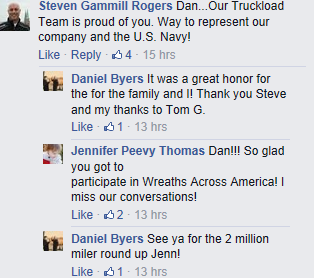
Daniel Byers represented our Truckload Fleet for J.B. Hunt in Columbus, Ohio yesterday.  Dan was responsible for driving the Columbus to Louisville leg of the trip.  Here are a few quick facts on Dan:

·         Navy Man —enlisted in 1973; Retired in 1995

·         Two Million Miler with J.B. Hunt

·         Married to Mary for 38 years

·         Children: Daughter and Son are both Iraqi Army veterans,  Younger son is a volunteer firefighter

·         Long line of military service throughout his family

·         Baseball fanatic; loves the Cleveland Indians

·         Also loves Nascar


Monday, December 8, 2014

Pride and Joy

Here is a great picture of our military wrapped tractor in Connecticut as we begin our inspired journey from Maine to Northwest Arkansas.  These wreaths will be placed at the Fayetteville National Cemetery and will honor over 9000 veterans.  Seven of our Professional Drivers from all three asset divisions will take part as we pass the keys.  Can you imagine the pride each one of our employees experiences as they command this tractor down the highway?
 

Thursday, December 4, 2014

How Do You Like J.B. Hunt?

These drivers obviously like working in Truckload.  They told someone else to come work for our company and we appreciate it!

These are the drivers who are active in Truckload that have made considerable amounts of money by referring drivers to come to work at J.B. Hunt.  We've actually paid 91 drivers $107,555 year to date.  Please thank your drivers who have helped refer a new driver to our company.    


Anthony Powell                                     POWA 7 $8,500.00
William Meyers MEYW 2 $4,000.00
Phillip Humphrey                                   HUMP1 2 $2,500.00
David Hutchins                                     HUTD 3 $2,250.00
Jayson Caldwell CALJ1 1 $2,000.00
Rebecca Cantu CANR50 1 $2,000.00
Daniel Frank                                       FRAD21 1 $2,000.00
Lawrence Johnson                                   JOHL11 1 $2,000.00
John Mitchell MITJ75 1 $2,000.00
Tavita Williams                                    WILT6 1 $2,000.00
John Adams ADAJ99 1 $1,000.00
Jose Alarcon                                       ALAJ 1 $1,000.00
Alex Asihene                                       ASIA 1 $1,000.00
Nicholas Bishop BISN 1 $1,000.00
Bryan Bittle                                       BITB 2 $1,000.00
Glenda Brailsford BRAG50 1 $1,000.00
Tracy Bussey                                       BUST15 2 $1,000.00
Rodney Collins                                     COLR11 1 $1,000.00
Will Harris HAWIL1 1 $1,000.00
Laquintin Jones JONL5 1 $1,000.00
John King                                          KINJ2 1 $1,000.00
Andrea Lewis                                       LEWA32 1 $1,000.00
Cynthia Mason MASC 1 $1,000.00
Woody Mcclinton  MCCW 1 $1,000.00
Michael Mendiola                                   MENM1 1 $1,000.00
Drew Milton MILD2 1 $1,000.00
Beryl Moore MOOB50 1 $1,000.00
Charles Morris MORC87 1 $1,000.00
Allen Ray                                          RAYA12 1 $1,000.00
James Roddy                                        RODJ97 1 $1,000.00
Jewel Sanders  SAN203 1 $1,000.00
Carl  Barbee BACAR2 1 $500.00
Brian  Barthalow BARB10 1 $500.00
Michael Bumbar BUMM 1 $500.00
Henry Cole                                         COLH0 1 $500.00
Alexander Feaster                                  FEAA 1 $500.00
David Friend                                       FRID 1 $500.00
Andy Graham GRAA69 1 $500.00
Richard Harris                                     HARR17 1 $500.00
Christopher Oxendine OXEC3 1 $500.00
Martin Richards                                    RICM6 1 $500.00
Ulysses Slaughter SLAU 1 $500.00
Treasury Smith                                     SMIT3 1 $500.00
Ernest Walker WAL2E 1 $500.00
Kenric Burden BUKEN2 1 $250.00
Richard Burrell                                    BURR0 1 $250.00
Damian Mason MASD41 1 $250.00
Benny Sealey SEAB0 1 $250.00

Wednesday, December 3, 2014

7 Lessons Learned About ELD's (Electronic Logging Devices)

1. ELDs force Fleet Managers and Load Planners to be involved in the details of driver schedules. They are just as, if not more, responsible for violations than drivers since they too have real-time visibility to hours.

2. DOT inspectors are far less likely to inspect a driver’s logbooks with a decal on the truck stating the vehicle is equipped with a compliant ELD device. When they do inspect e-logs, some officers will call the fleet to ask for a company code to view the logs online through the vendor’s website.
 
3. Have measures in place when ELD devices go down, because they will. Provide drivers with an instruction sheet for who to contact to receive a fax, an e-mail or login credentials to a website where drivers can retrieve the last 7 days of work activity. Also, have drivers carry a paper logbook for backup. Draw a line on the paper grid at the time the electronic unit went down. Don’t back up the paper logbook for the entire day, as that could contradict the electronic record.

4. Customers can be the biggest challenge when implementing ELDs. Besides detention time at docks, some shippers disallow drivers from staying on their property beyond a short time limit. Drivers that hit their 14-hour or 11-hour drive limit while in a shipper’s parking lot could be forced to violate the hours-of-service rules by moving offsite. Carriers believe shippers should be liable in such instances, but currently the law makes no provision that would allow drivers to go a few extra miles to find a “safe harbor” once their time has expired.

5. Use the “miles without hours” report to catch drivers trying to cheat the system, such as going off duty and then turning the system off or disconnecting the power cord. With paper logs it was much easier for drivers to slip into the sleeper berth in North Carolina and mysteriously wake up in Florida.

6. Personal conveyance is a gray area with ELDs, especially for owner operators, so choose a policy and stick to it. The policy should specify when, where and for how long drivers are allowed to use it. For example, if a driver runs out of hours when dropping a trailer at a company terminal or customer location, do you allow the driver to bobtail 5 miles to get home? How about 100 miles?

7. Unforeseen circumstances. Hours-of-service regulations allow drivers to extend on duty time by two hours for unforeseen circumstances like weather. One fleet owner said this is a gray area that can be used sparingly, if necessary, in situations where drivers would otherwise go over their hours-of-service limits. If you do use it, make sure the driver does not move for two hours. “We don’t use it so often,” he said. “We try to avoid that gray area.”

Hours Of Service

Five years ago, Al Beers “swore to God” that his company would never use electronic logging devices (ELDs). That oath softened when Karr Transportation’s Compliance, Safety, Accountability scores went up and finally broke apart when the company was audited by the DOT.
“This is what we are going to have to do,” he concluded. Karr Transportation implemented ELDs and Beers, president of the 35-truck fleet based in Lavergne, Tenn., saw an immediate impact on CSA scores by virtually eliminating hours-of-service violations.
 
The days when drivers, dispatchers and shippers could count on the “flexibility” of using paper logbooks (known in some circles as swindle sheets) to mask inefficiencies in the supply chain are long gone. Beers now has a message for drivers that want to keep trucking beyond what the law allows.
“If you go out and kill someone, you’re going to prison for the rest of your life. Your kids are going to be without you. Your wife is going to be with another man raising your kids. And all for what, so you could get a load there on time? It’s not worth it,” he said during a breakout session at the CCJ Spring Symposium in Nashville, Tenn., on May 20.
 
On the downside, Karr Transportation saw a decrease in revenue from lost productivity. That problem was short lived. Drivers and dispatchers learned how to use the technology to plan more efficient routes and schedules.

“We showed drivers that we can make them more productive,” he said.

Similar stories emerged from fleet executives and managers during the breakout session on ELDs.
One year ago, Lori Rustin from Boyd Bros. Transportation was training drivers for the 750-truck flatbed carrier headquartered in Clayton, Ala. She was offered a new job as safety manager as Boyd Bros. was in the process of implementing ELDs.

With 18 years’ experience in transportation, including time spent behind the wheel as a driver and trainer, Rustin — like most people at the company — knew little about the technology.
“I don’t think I slept 5 minutes,” she said about the day she accepted the job. “What kind of problem is this going to be? How are drivers going to accept this?”
 
The biggest obstacle was combating drivers’ pre-conceived notion that the technology would make their lives more difficult. To disprove this, Boyd Bros. Transportation started by asking 11 drivers well versed in hours-of-service rules to use ELDs.

The 11 drivers shared their experiences with other drivers. Soon, other drivers came forward to adopt ELDs voluntarily. Boyd Bros. required all of its new driver hires to use ELDs. One year later, approximately half of the fleet is on electronic logs and ahead of schedule to be fully deployed by the time the ELD mandate takes effect, which could be as early as 2016.
For Boyd Bros., the transition to ELDs involved training managers and load planners to use new software that provided live visibility of drivers’ hours, she said. Previously, drivers would supply their hours-of-service status through mobile communications.
The benefits of ELDs, Rustin said, have been tangible improvements in CSA scores, fewer DOT inspections, virtually zero missing logs and a much more efficient way to manage compliance.

Rustin’s presentation and the discussion among fleet executives and managers covered a variety of topics that are important to consider when implementing ELDs, all of which every carrier and driver will soon encounter if they haven’t already.